Product
Marketing Agents
The commercial pillar for the workspace: which agents exist, where humans approve, and how the platform replaces disconnected contractors.
Open Marketing Agents →How it works · measure · execute · prove
Hermes measures how AI engines describe your brand. You choose the closeable gap, run Marketing Agents to produce the page or source asset, approve it, publish, and re-measure the lift every week. On every plan a person from our team is one message away.
Tracked across
Why the route exists
The Humanswith.ai workflow keeps measurement, content, technical SEO, and reporting in one workspace, so every asset is tied to a visible gap and every week ends with proof.
01 · Input
We start with the exact prompts, engines, competitors, and source surfaces that shape buyer recommendations.
02 · Agent work
Marketing Agents produce the work package: source-backed copy, structure, schema, visuals, and publish handoff.
03 · Human gate and proof
You approve sources, claims, channel fit, and publication. The next Hermes scan shows whether mentions, citations, and recommendation context changed.
The workflow
You run the loop inside the workspace. The engineer who presents the first audit stays one message away on every plan.
The operating principle: every page or article exists because a measured visibility gap demanded it. That is how we avoid content volume for its own sake.
Before step one
Workspace · readiness
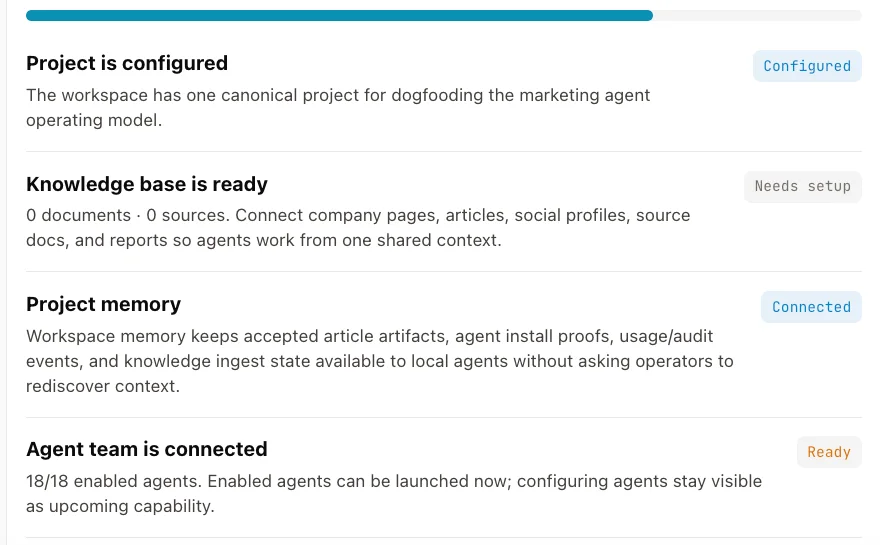
Four things have to be true before the first scan is worth running. The project exists. The knowledge base holds your material. The memory is connected, so nobody re-explains context every week. The agents are enabled — here 18 of 18.
Look at the second row: needs setup · 0 documents · 0 sources. That is day one. The checklist says so rather than showing a green tick, and you will see this screen with that row amber. Turning it is most of week one.
What ships in the first cycle
Measurement layer
Prompt set, nine-engine scan, competitor comparison, source map, and a priority list for the first two to three closeable gaps.
Content layer
Commercial page updates, citation-ready articles, comparison sections, case proof, FAQ blocks, and channel-ready adaptations.
Website layer
Schema, internal links, llms.txt, crawler access, sitemap hygiene, redirects, and route-level evidence that AI systems can parse.
Operating windows · not guarantees
We keep three clocks apart because collapsing them into one result date would overstate the evidence.
~7 days
Early citation signals can appear after publishing and indexing. This is the first checkpoint, not a promised result date.
36 days
We use a longer window to collect a broader citation picture across prompts and engines. It is not the time to first citation.
48 days
This is our portfolio-review watch window. The exact threshold was not independently validated, so we do not present it as a universal citation-decay law.
Where to go next
Product
The commercial pillar for the workspace: which agents exist, where humans approve, and how the platform replaces disconnected contractors.
Open Marketing Agents →Module
The production module that turns a visibility gap into a source-backed brief, draft, schema, quality report, and approval-ready packet.
Open ContentOS →Technical layer
The technical layer for schema, llms.txt, crawler access, internal links, and website readability for AI systems.
Open Website Agentic →Plans
Five plans that run this same loop. They differ only by how many AI engines are scanned and how many articles ship each month.
See the plans →Publishing policy
The canonical-first rules for channel adaptations, cadence caps, visible source links, and stop conditions.
Open the guardrails →Workflow questions
An engineer runs a Hermes scan of your brand, three competitors, and the main AI engines before the call. The call starts from evidence: where AI names you, where it names competitors, which sources it cites, and which gaps are closeable.
A visibility audit reports what AI says today. The Humanswith.ai workflow turns that report into approved work: canonical pages, source-backed articles, schema, llms.txt, case pages, distribution assets, and weekly re-measurement.
Humans approve the source set, the claims, the page or article, the channel adaptation, and the final publish step. Agents do the repeatable work; you keep control over positioning and risk.
We use roughly 7 days as the first-signal watch and 36 days to collect a fuller citation picture across prompts and engines. These are operating windows, not guarantees. Competition, source availability, indexing, and starting visibility can make the result earlier or later.
The first assets are usually a canonical commercial page, one or two citation-ready articles, a case or proof page when data is available, and technical website fixes that make those pages readable by AI crawlers.
No. It changes the operating target. SEO still matters for crawl, authority, and commercial discovery. AEO/GEO adds the layer that makes AI engines cite or recommend the brand inside answers, not just show a blue link.
Start with evidence
You see the baseline, the likely first asset, and the tier that fits. If the category is not ready for measurable AEO/GEO work, we say that too.